

Nomadic Bags
"Scroll down to explore the collection of nomadic bags I collected during my fieldwork and later donated to the collection of the Oriental Museum at Durham University.”
Professor Susan Wright
This bag is called a hur charkh and is used to carry heavy household items.
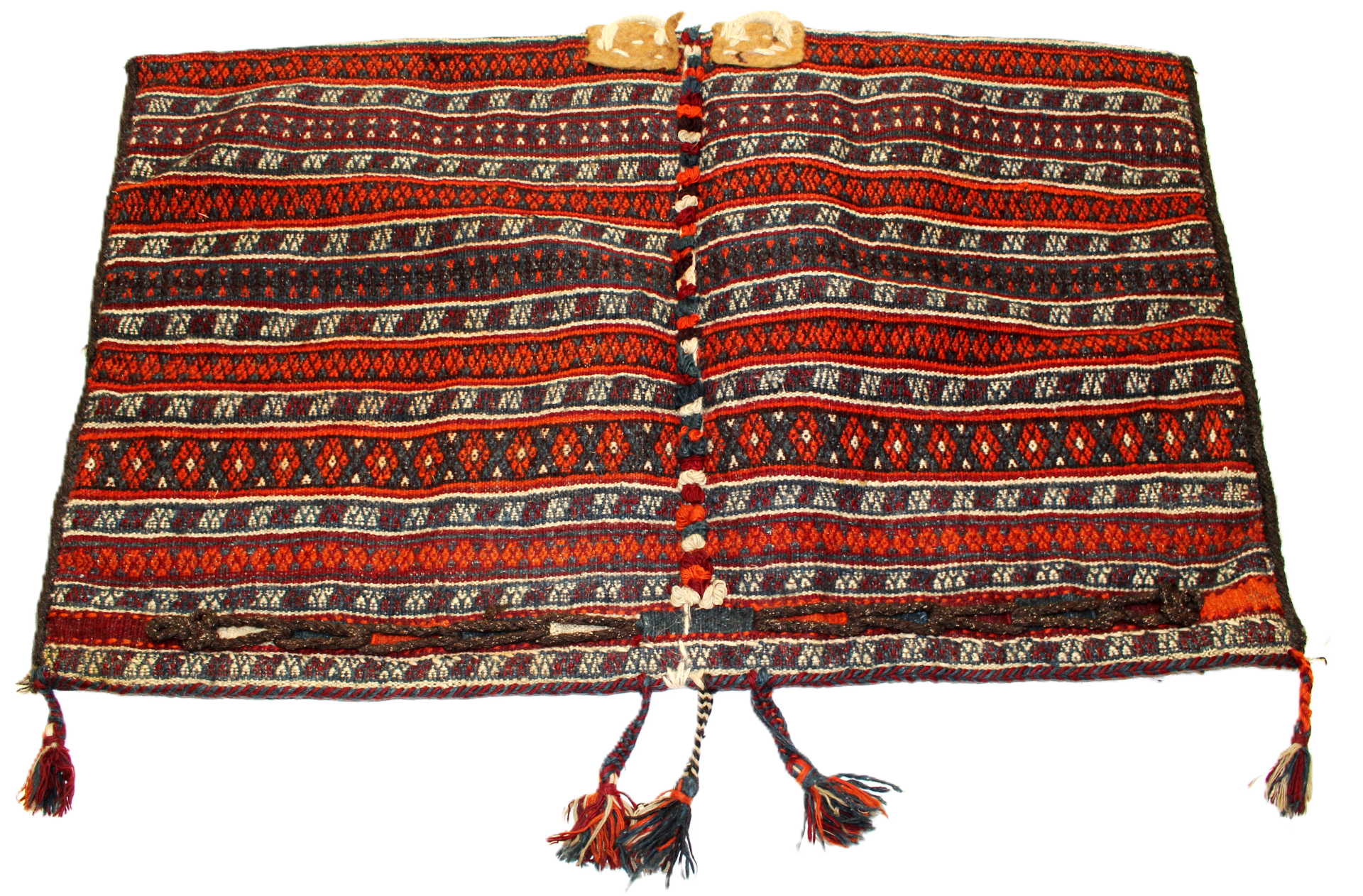
It is woven as a single piece, 78cm wide and 250cm long, with an elaborate design for the front and a simpler version for the back.
The length is then folded in half and the sides joined with strong stitching called shirazeh. Stitching along the bobbled centre line makes the cloth into two bags, which hang on either side of the donkey.
Thick and hard wearing, the warp is spun goats’ hair and the weft is sheep’s wool. The weaving is called gachmeh bafi.
Two hessian reinforcements and undyed whipped woollen loops are for tying a rope called a palim under the donkey’s tail. This prevents the load from falling forwards when travelling downhill on migration.
On each side at the front are dark loops made of plaited goats’ hair. Each bag is closed by passing the farthest loop over its neighbour and so on until reaching the centre, then the penultimate loop is passed over and back through the final loop, thus making a reef knot.
This quick way of opening or closing the bag is built into the design without needing additional ties or paraphernalia.

حور چرخ, Hur charkh
حور چرخ, Hur charkh

شلنگی, Shalangi
شلنگی, Shalangi
This large, double bag is called a shalangi. It is not so thick and hard wearing as the hur charkh and would be used for carrying clothes or lighter things.
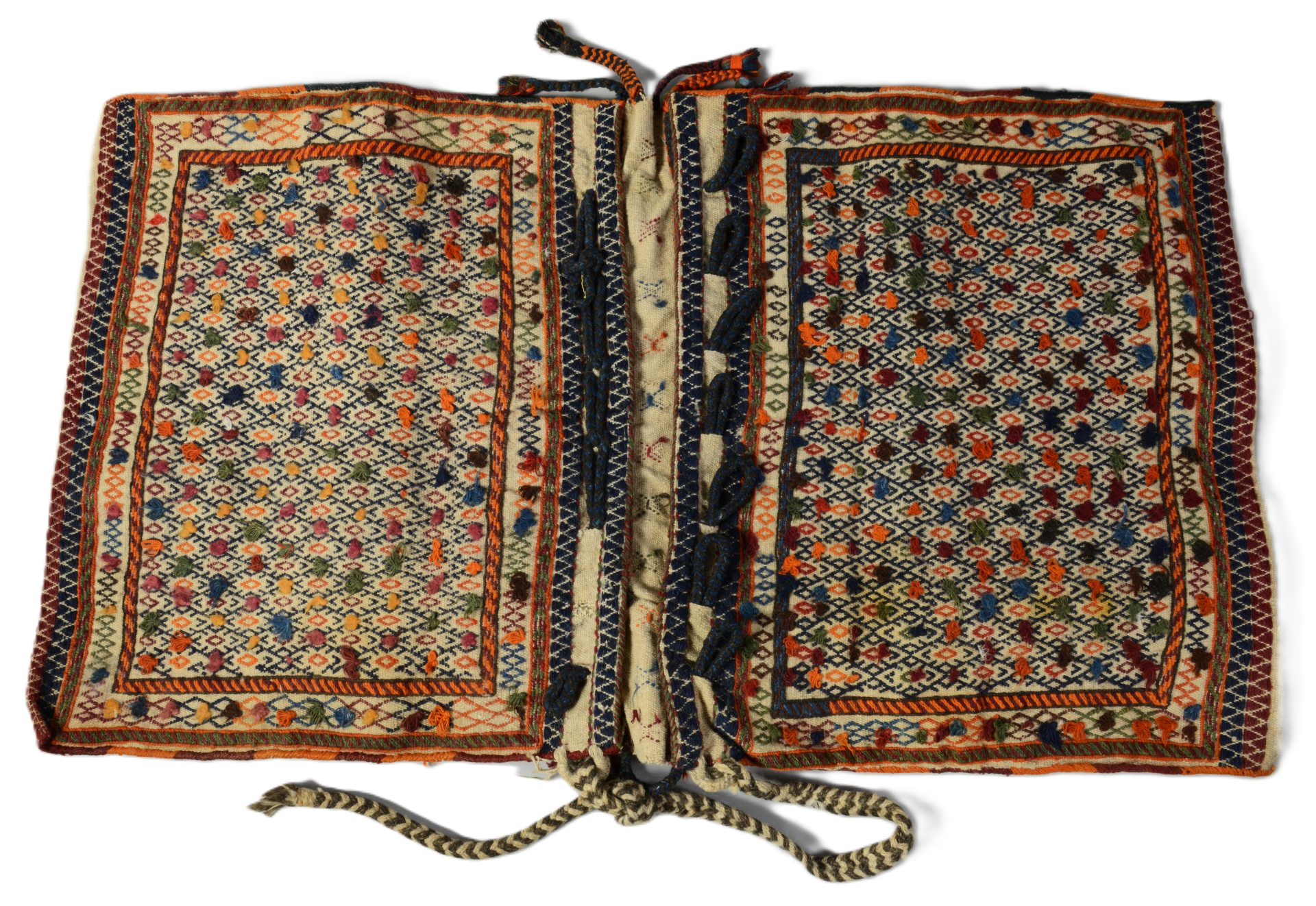
Measuring 133cm x 77 cm, it is woven as a single piece, this time starting with one of the elaborate font sections, then the whole of the reverse side, and finally the other front section.
The sides are oversewn and the two bags hang on either flank of the donkey with the openings at the top. The bags are closed with the same system of interlaced loops as for the hur charkh.
The warp and weft are both made of wool. The base colour is undyed wool and any coloured wool used has been dyed with natural dyes. The weaving pattern of little coloured diamonds is called durna and the pompoms are woven into the fabric, not sewn on afterwards.
The decorative tassels would hang by the donkey’s neck, and at the other end, a plaited rope would go round the donkey’s tail.
This is a khurjin. It is smaller than a shalangi, measuring 100cm x 60 cm, and it is used for carrying similar goods.
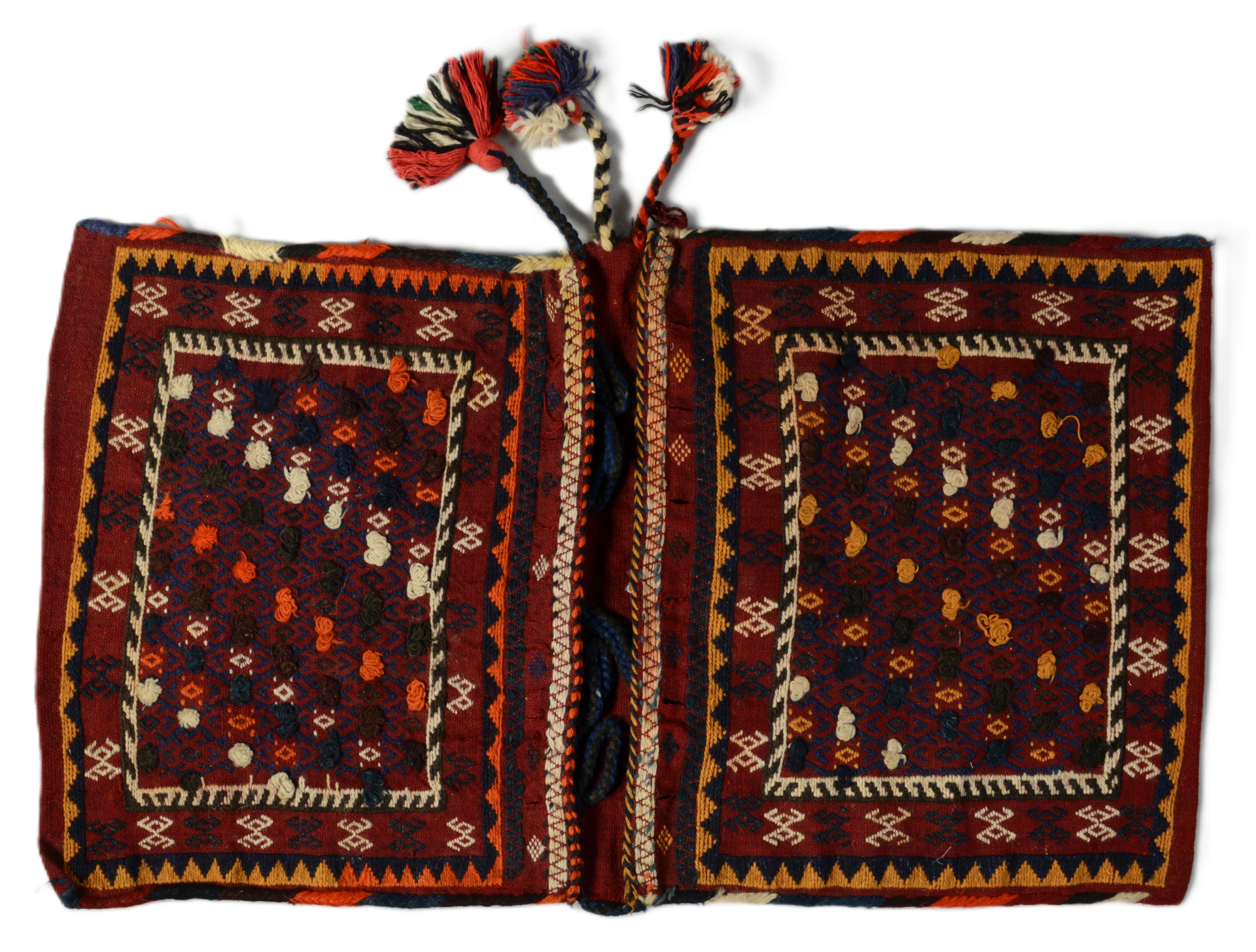
It is made in the same way and using the same durna pattern but with more flamboyant and coloured pompoms included in the weave.
The colours come from natural dyes and the maroon base coloured wool is probably dyed with the green hulls of walnuts.
It is a very fine quality bag and said to look beautiful on a horse as it moves.

خورجین, Khurjin
خورجین, Khurjin

جا جعبه, Ja jabeh
جا جعبه, Ja jabeh
This a special rucksack, called a ja jabehwhich would be used for carrying a wooden box with a china tea pot and tea glasses. This was carried with great care because tea-drinking was a crucial feature of nomadic life and still marked out the villagers’ day.
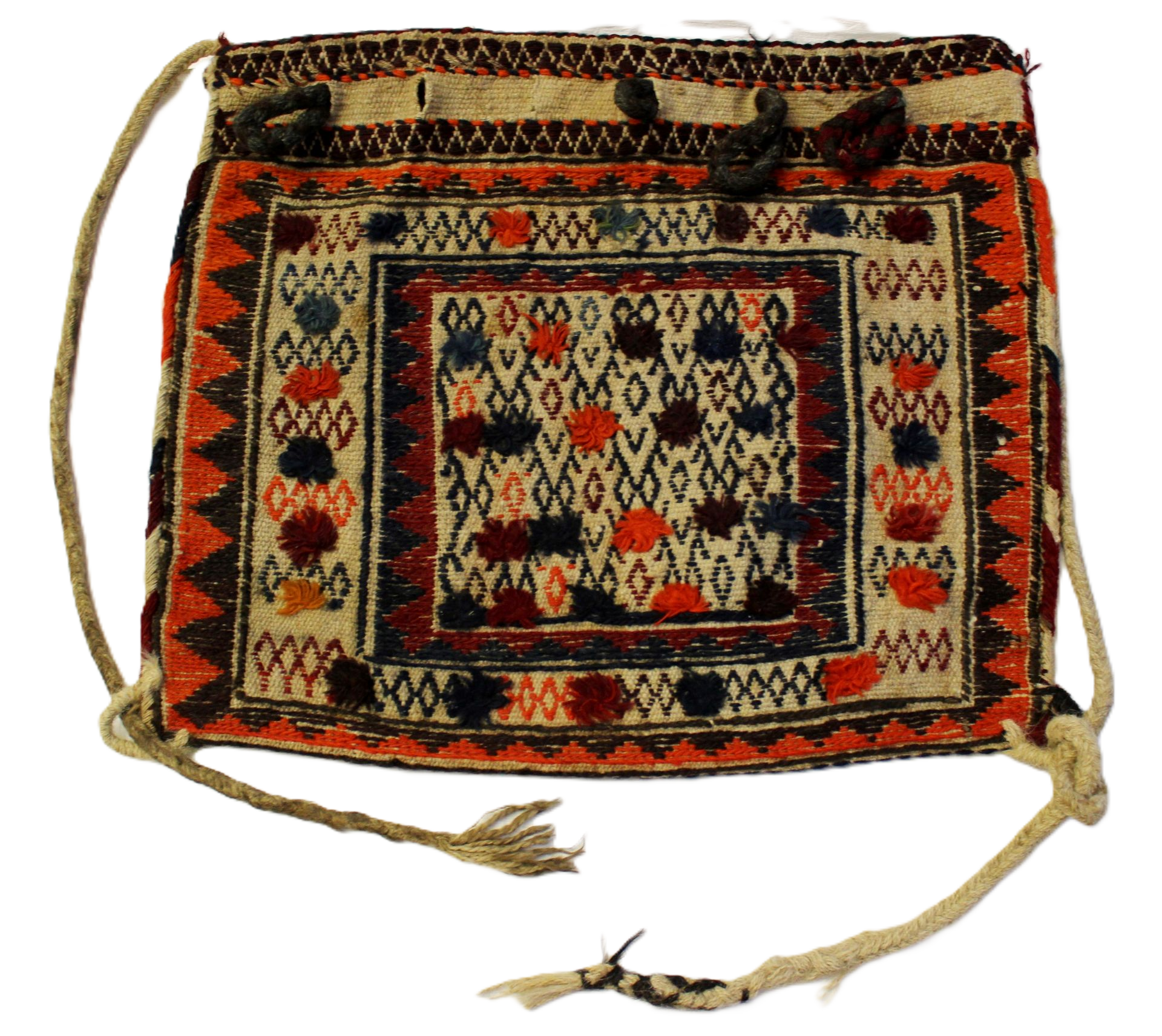
To prevent teapots from breaking, one person in the village was skilled at reinforcing them with thin metal strips. On migration, tea would be drunk first thing in the morning, and as soon as the day’s migration ended.
This ja jabeh measures 50cm x 60 cm. Along the top, a row of black loops is used to close it in the same way as described for the hur charkh. On each side is a strap of plaited wool to go over the carrier’s arms.
The warp and weft are both made of wool. The base colour is undyed wool and coloured wool has used natural dyes. As with the shalangi, the weaving pattern of little coloured diamonds is called durna with pompoms woven into the fabric.
Rucksacks in general were called torbeh , and usually made of black goats hair with the same weave as the tent tavar and shalleh. People used them to carry food and water when they went to work in the field for the day.
This bag, measuring 100cm x 38 cm, is called gheylun dun and is specifically for carrying a water pipe or hubble bubble, but might also carry other long items such as the rolling pin for making flat bread.
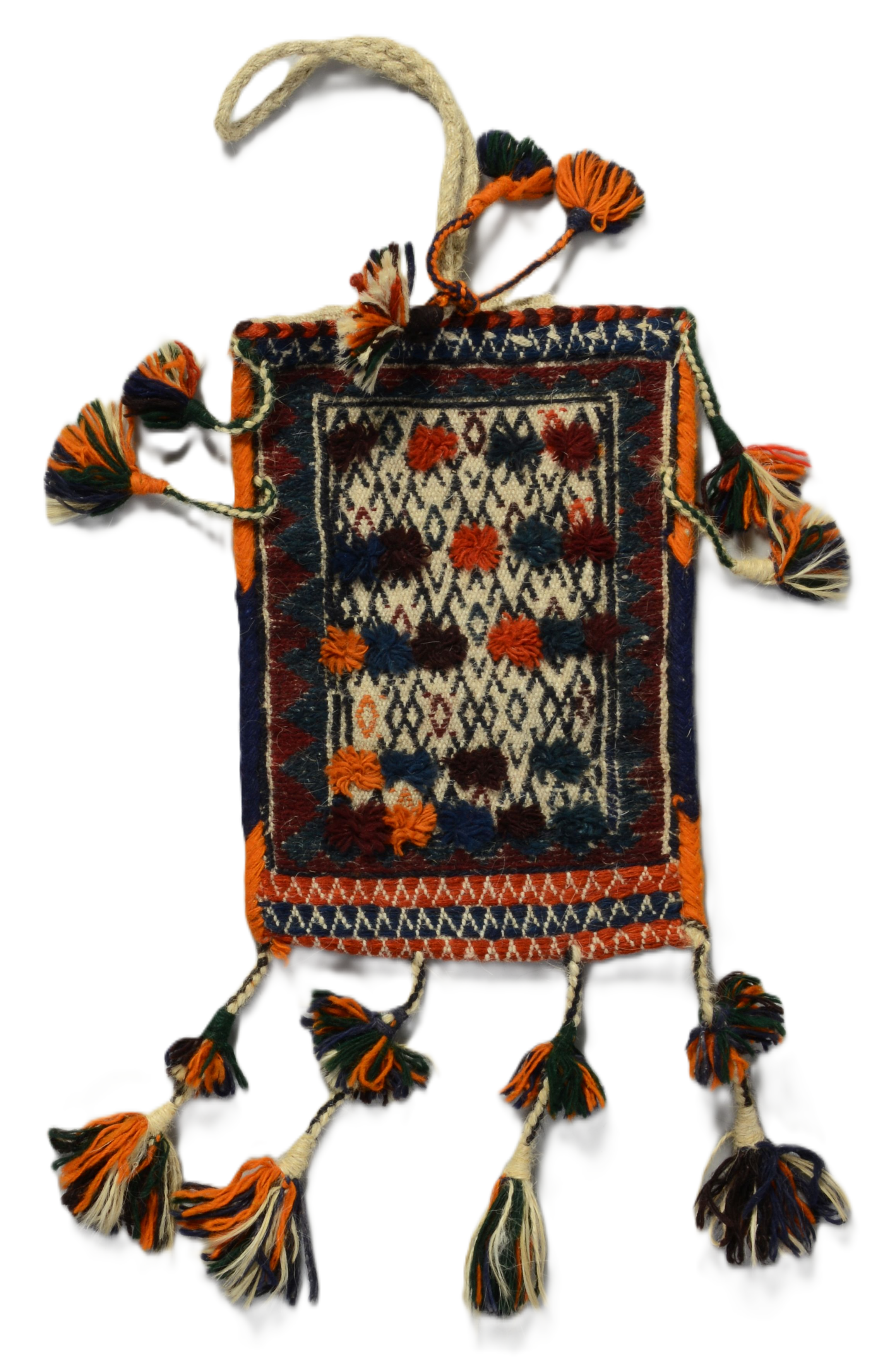
It is highly decorated in the same design as the rucksack but with more tassels (called gombul ).
The rear, like all the bags of this design has a simpler pattern. Its long plaited woollen strap could either be used for carrying it over a shoulder or to tie it carefully on top of a donkey’s load. Once the tent was erected it would be tied to a tent pole.

قیلون دون, Gheylun dun
قیلون دون, Gheylun dun

تیوری, Tivari
تیوری, Tivari
This is called a tivari (or namakdun in Farsi) and measures 60cm x 40cm.
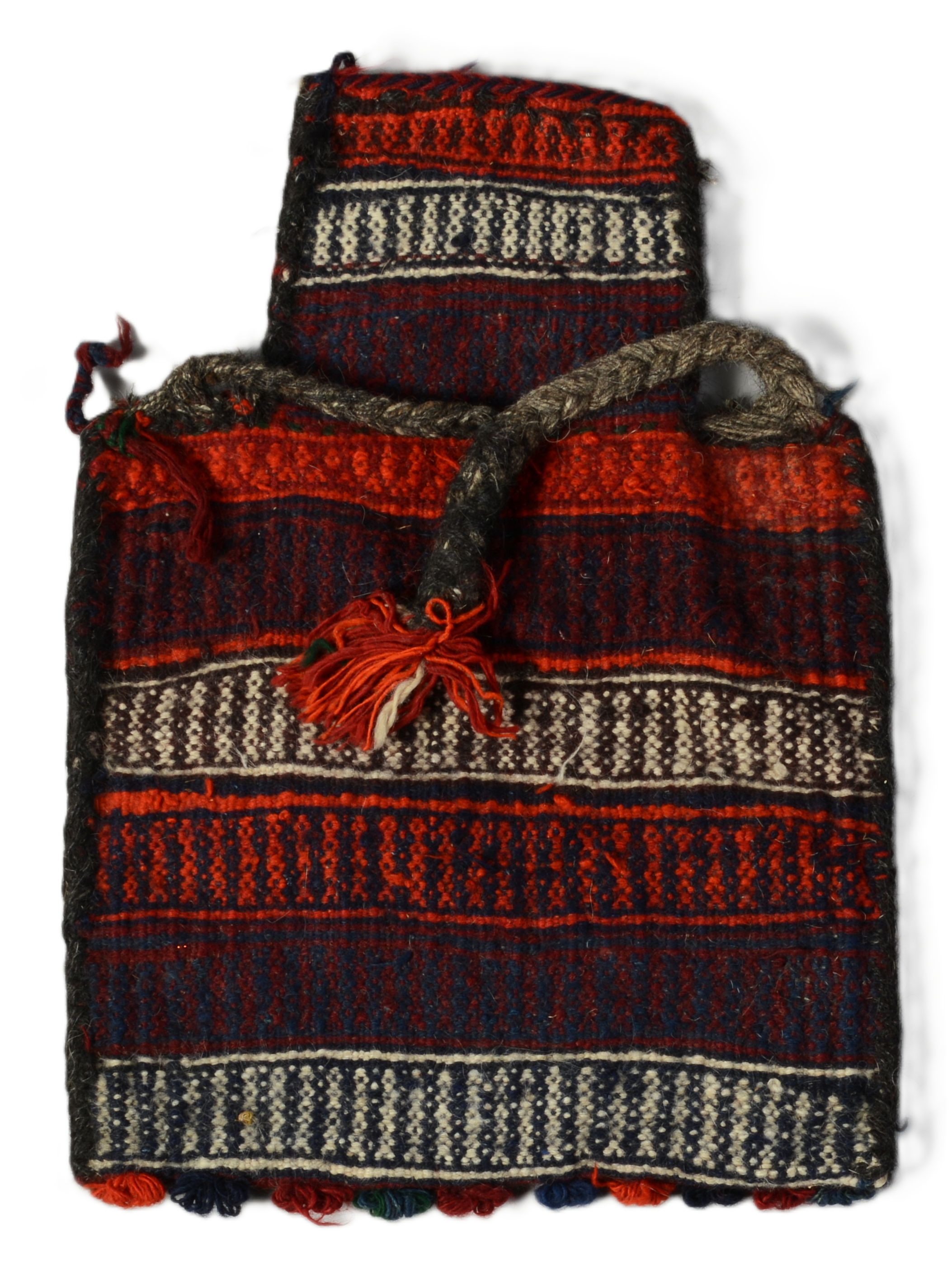
It is used for salt and is made in the same heavy weave as the hur charkh, which makes it fairly water proof.
The plaited handle is attached to the shoulders of the bag, so that the neck falls forward, and, without the need for any clasp, prevents dust or rain falling in during migration.
When the tent is up, it hangs from a tent pole, making it easy for the woman to put her hand in the neck and quickly access salt when cooking.
This highly decorated bag measuring 40cm x 38 cm is called eynadumor mirror bag.
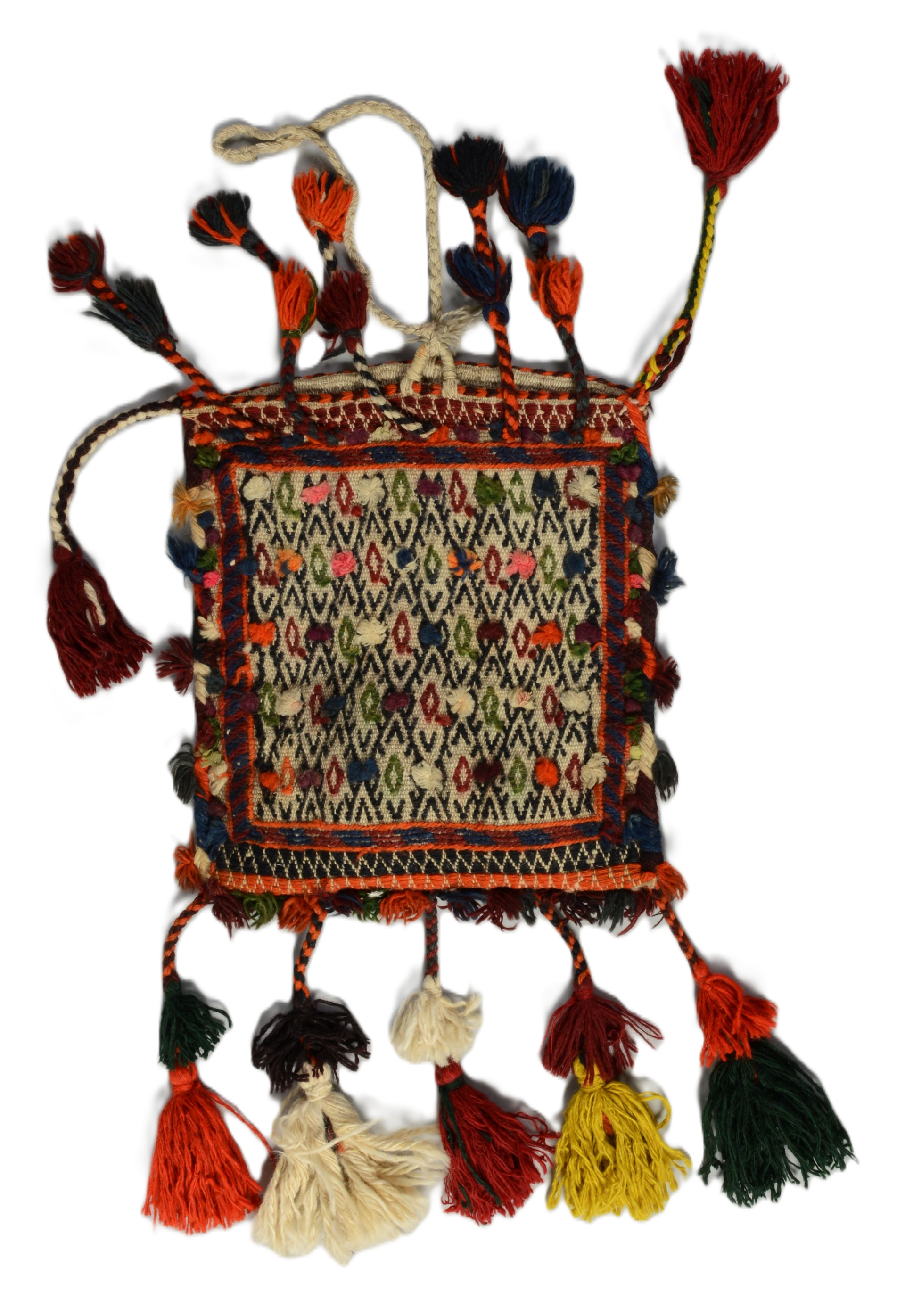
It contains a mirror and on her marriage day it is carried head-height in front of the bride as she leaves her father’s house and begins her journey to the groom’s family home.
It was hung permanently in the tent, and is still hung in village houses. In addition to the mirror, it is where the wife keeps precious things like a comb, black eyeliner called sirmah, and scissors.

اینه دون Eynadum
اینه دون Eynadum

Char bandi چار بندی
Char bandi چار بندی
This bag is called a char bandi. It measures 22cm x 26 cm and is woven in the same thick and strong way as the hur charkh but in addition, in the centre, it has a ring of pompoms woven into the fabric, like the gheylandun.
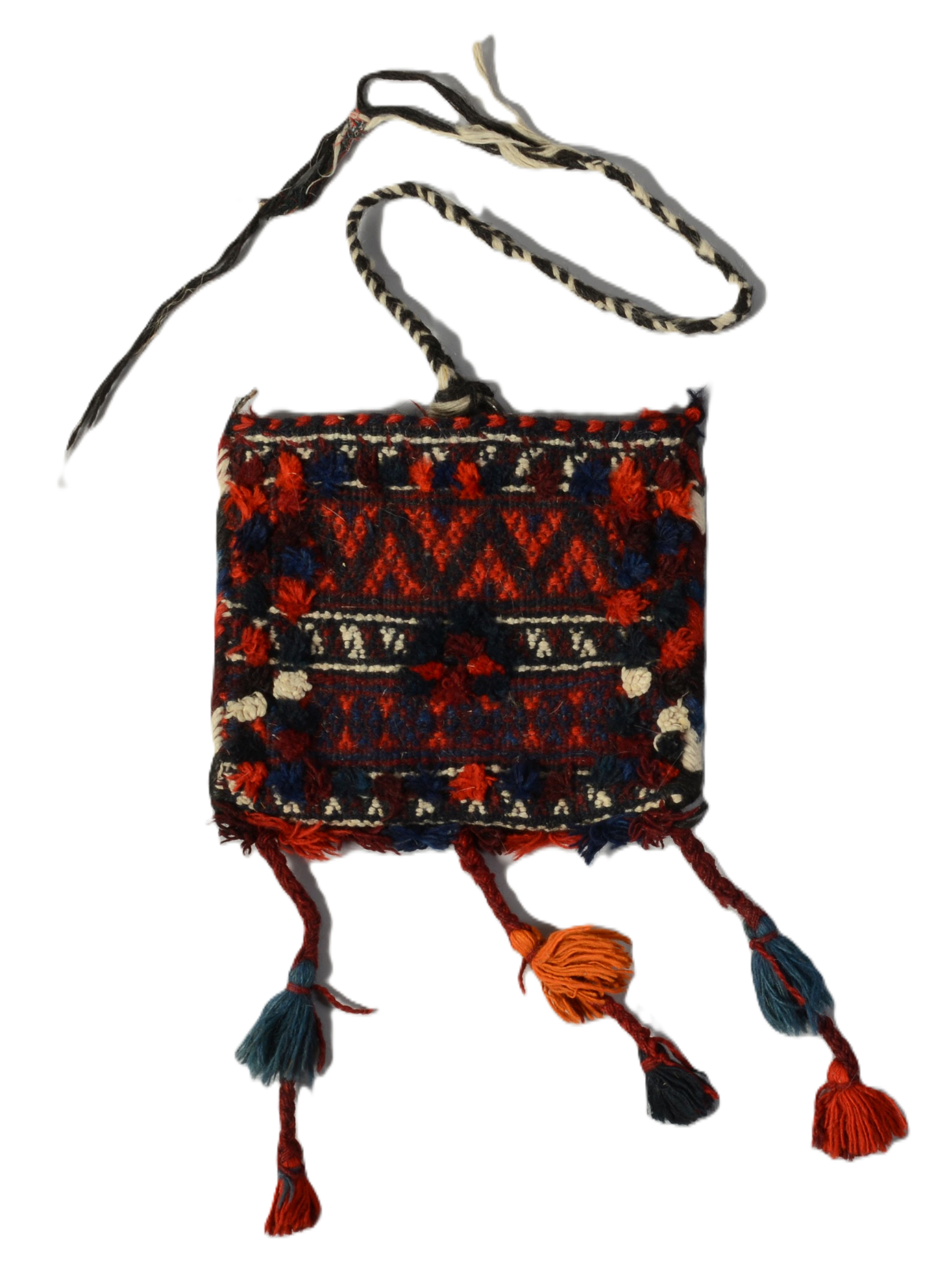
It was made by Mrs Manovar Razmjooei but is unfinished and would have more tassels along the bottom and the top, like the mirror bag.
It would be used for carrying precious books, like the Koran or the poems of Hafez, expensive spices such as saffron, soap and sewing kits.
At New Year, the bag would be emptied and given to small children to go from house to house very early in the morning, in search of celebratory sweets.
This is a halter rope called a band-e hasht dar hasht.
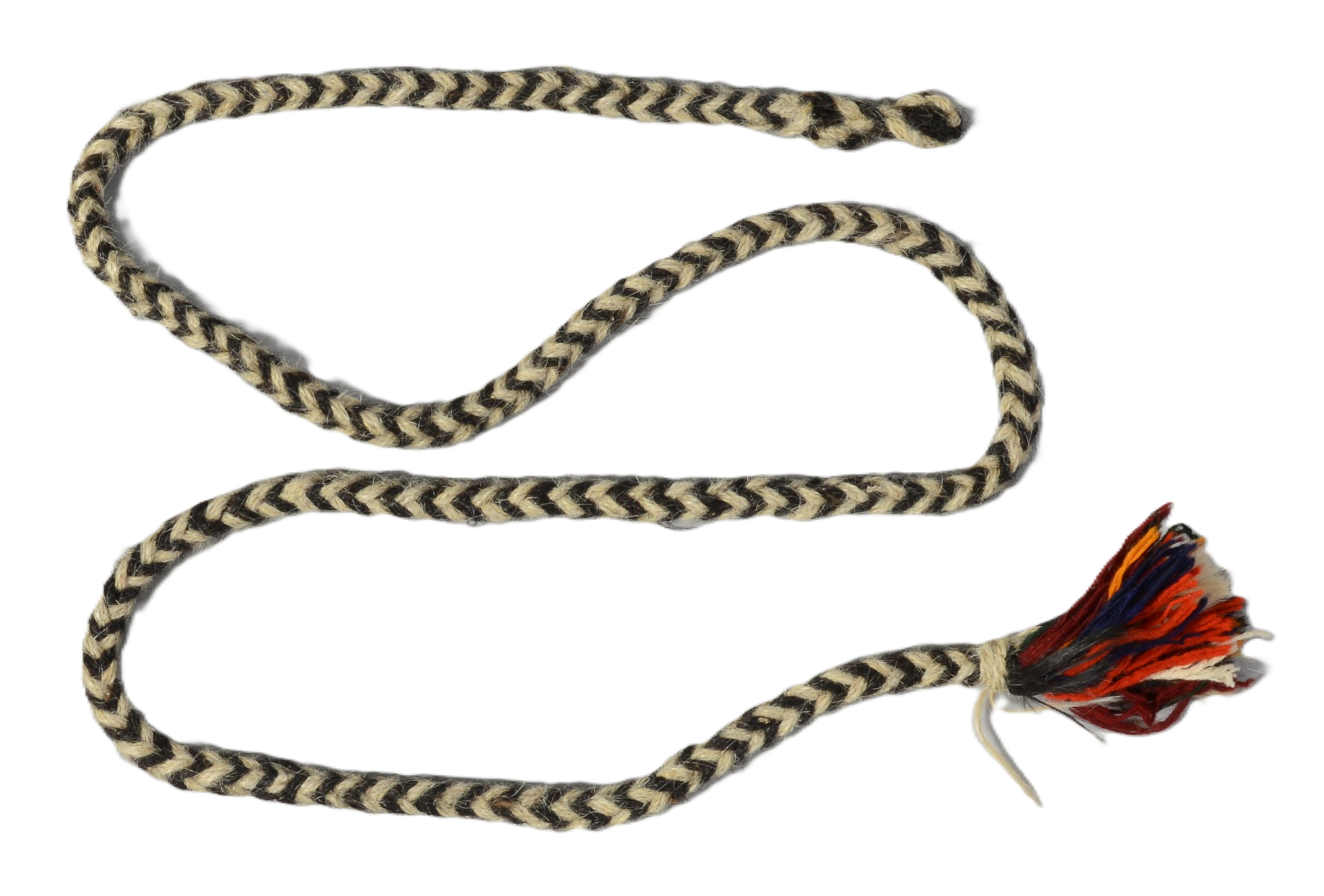
It is made by what is called circular weaving, is over 200 cm long, made by plaiting black goat’s hair and natural sheep’s wool, with a loop at one end and a multicoloured tassel at the other.
It is an essential asset on a migration, for leading a horse or a donkey. A bride would often give this elaborate version as gifts to guests at her wedding.
There is a range of different kinds of plaited ropes, each with a different purpose. For example the picture below shows a much longer flat rope used to tie a load on a donkey.
Because this looks like two number eights in Persian it is called hasht dar hasht.

Band-e hasht dar hasht
Band-e hasht dar hasht
 Built with Shorthand