

Nomadic Weavings
From Sheep to Carpets in Rural Iran
This is the story of traditional hand-woven goods made by a formerly nomadic rural community. Understanding how these goods were produced and used takes us inside the complex social and political changes of 20th Century Iran and the lasting impact this had on communities.
In the 1970s, the Shah of Iran embarked on a project to create a modern state, with government bureaucracies, military forces, mechanised farming and new industries. This brought benefits to a new urban middle class but, at the same time, impoverished the countryside.
The Shah's father had seen nomadic communities as a political threat and had carried out a programme of forced settlement. Living in villages fundamentally altered a way of life established in families for generations.
The forcible settlement meant these groups no longer needed the woven bags and carpets that were essential for migration. Each one had a different use, design, and pattern, but the skills of making and understanding these textiles were gradually fading away and at risk of being lost.
In this context, anthropologist Professor Susan Wright began her fieldwork living amongst the nomads and villagers to see how they responded to the modernising state, economically, politically and socially.
“For 16 months in 1974 and 1975-6, I lived with settled nomads in south-west Iran in the places highlighted on this map.
The area, called Doshman Ziari, Mamasani, is divided into 12 sections, and I stayed with families in the villages, hamlets and nomadic camps that made up one section (approximately 2,500 people).
They allowed me to join in the everyday activities of men, women and children, they taught me their Luri language, and they shared their histories and their struggles to cope with and improve a very hard life.
This was an enormous privilege, for which I send them a heart-felt Thank You."
Throughout the exhibition, click on the images with this notebook icon to read more of Professor Wright's fieldnotes.

Migration Stories
"In Spring, the deep snow would soon melt, and the summer was pleasantly warm."
Before the forced settlement, communities migrated between winter and summer quarters.
The winter quarters were in a lowland area that avoided the worst snow. In early spring, as this area heated up, families travelled 4-5 days up into the Zagros mountains to seek cooler weather.
Herds of sheep and goats were shepherded on the journey and household goods were transported on donkeys. In late autumn they would migrate back down to the winter quarters.
This annual movement across altitudes was not only to find areas for animals to graze, but also to keep the sheep within a consistent temperature range.
When they were forcibly settled, some families stayed in the winter quarters but most moved to the summer quarters, building a main village and some smaller hamlets to protect their territory.
Nearly all of the villagers kept a few sheep and goats, but only a small number continued to migrate.
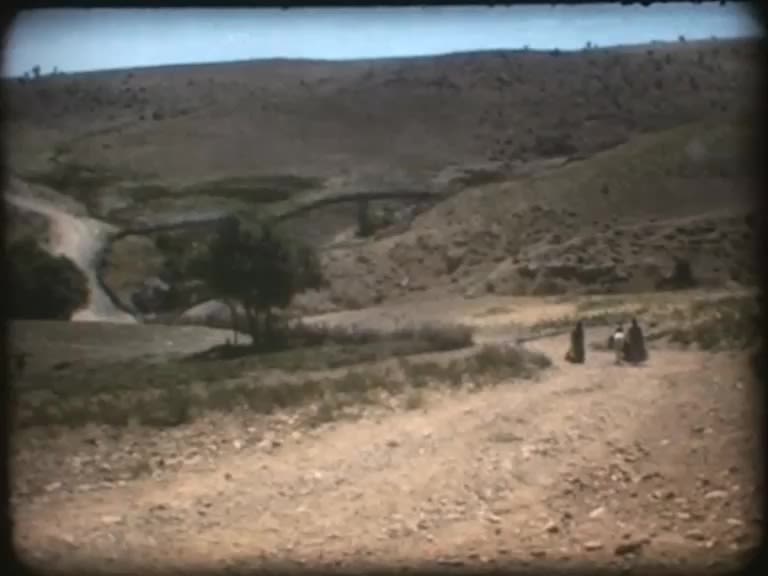
Those who managed to keep migrating, travelled annually from the winter quarters.
These nomads had bigger herds, allowing them to earn a better living.
Nomads with smaller herds needed to collaborate with other community members, combining nomadism with other tasks in the new mixed economy.
Camps used by the nomads in the high mountains were organised with the tents facing inwards and flocks were fenced in with a ring of thorny branches around the camp. This kept the wolves out and divided the space for each herd.
Each tent belonged to a different family or their shepherd. Every month or so, the camp group would move to another of the known campsites in the mountains.
Those who stayed in the summer quarters all year tended to have smaller flocks of animals.
Older children could stay with relatives in the main village to go to school and might help with the herding in the summer.
Some woven items were still in use. Families that went to the mountain in the spring still used their black tents called bohun. These woven goat hair tents were ideal for the changing weather conditions.
When it rained, the weave closed up making the tent waterproof. In hot weather, the weave expanded and ventilated the tent.
Big bags of woven goat hair called tavar were still used to carry loads of wheat straw or other winter fodder.
This video shows the black goat-hair bag called shalleh, used to collect goats skins of water from the spring.
Families also still used the heavy-weight donkey bags called hur for carrying wheat, grapes or other produce.
“Although they still used some textiles, this change in lifestyle meant that communities no longer needed many of their nomadic bags used during migrations.
They tried to sell them in the Shiraz bazaar but they fetched no reasonable price, so I bought a selection of all the types no longer made.
These are now part of the collection of the Oriental Museum at Durham University.”
This kind of bag was hung over a donkey and used to carry heavy household items. The warp is goat hair and the weft is sheep wool.
This kind of bag was hung over a donkey and used to carry heavy household items. The warp is goat hair and the weft is sheep wool.
There are two metal hooks at bottom end of this bag, to attach it under the donkey's tail.
There are two metal hooks at bottom end of this bag, to attach it under the donkey's tail.
This rucksack is designed for carrying a tea canteen. One of the cords is muddy from use.
This rucksack is designed for carrying a tea canteen. One of the cords is muddy from use.
This bag was used during wedding ceremonies to hold a mirror and other high value items. The dangling tassels indicate high value contents.
This bag was used during wedding ceremonies to hold a mirror and other high value items. The dangling tassels indicate high value contents.
This style of small, flat-weave donkey bag was used for light household goods.
This style of small, flat-weave donkey bag was used for light household goods.
This is a larger donkey bag with a widely used pattern.
This is a larger donkey bag with a widely used pattern.
This bag was made to carry a water pipe or hubble bubble.
This bag was made to carry a water pipe or hubble bubble.
Plaited items like this horse halter rope were often given by the bride to guests at her wedding.
Plaited items like this horse halter rope were often given by the bride to guests at her wedding.
This bag was used to carry salt. The neck of the bag is designed to flop over and protect the salt from the weather.
This bag was used to carry salt. The neck of the bag is designed to flop over and protect the salt from the weather.
Bags like this were used for carrying expensive spices such as saffron and domestic items such as sewing kits and eye make-up.
Bags like this were used for carrying expensive spices such as saffron and domestic items such as sewing kits and eye make-up.
Press the button below to find out more about how these unique nomadic bags were made and used.
Village Living
“The crisp air of early morning would fill with animals’ bells and herding calls as women took their animals to the meeting spot, shouting greetings to each other as the shepherd drove the flock out for its day in the hills.”
Settlement in the villages meant a different way of living, combining the traditions of animal keeping, with farming a range of crops.
The range of altitudes and soils allows different crops to grow, including grapes, wheat, rice and barley. Men in the village were responsible for sowing, growing and harvesting the crops. As most families kept fewer animals, neighbours herded their combined flocks in turns or collectively hired a shepherd.
Despite diversifying their economy and producing crops to sell, there were only rocky dirt roads connecting the villages to urban markets. This made it difficult to transport goods for sale. The national import of wheat also undermined prices for local producers, making the cost of production unsustainable.
Click the icons on the image below to hear some of the common sounds of village life.
Every member of the family had daily chores in the villages.
In spring, small children herded new lambs and kids near their settlement.
Women milked the sheep and goats into a large metal pot.
The milk was used to make fresh yoghurt, dried yoghurt called kashk, butter and cooking oil.
Men gathered wild plants, kangar and jashir as winter fodder for the animals.
Kangar, a very prickly thistle, is collected with very a long wooden fork and hook.
Jashir is harvested in May with a serrated hand sickle, removing all the plant growth but protecting the roots.
These processes continue today, as seen in the videos below.
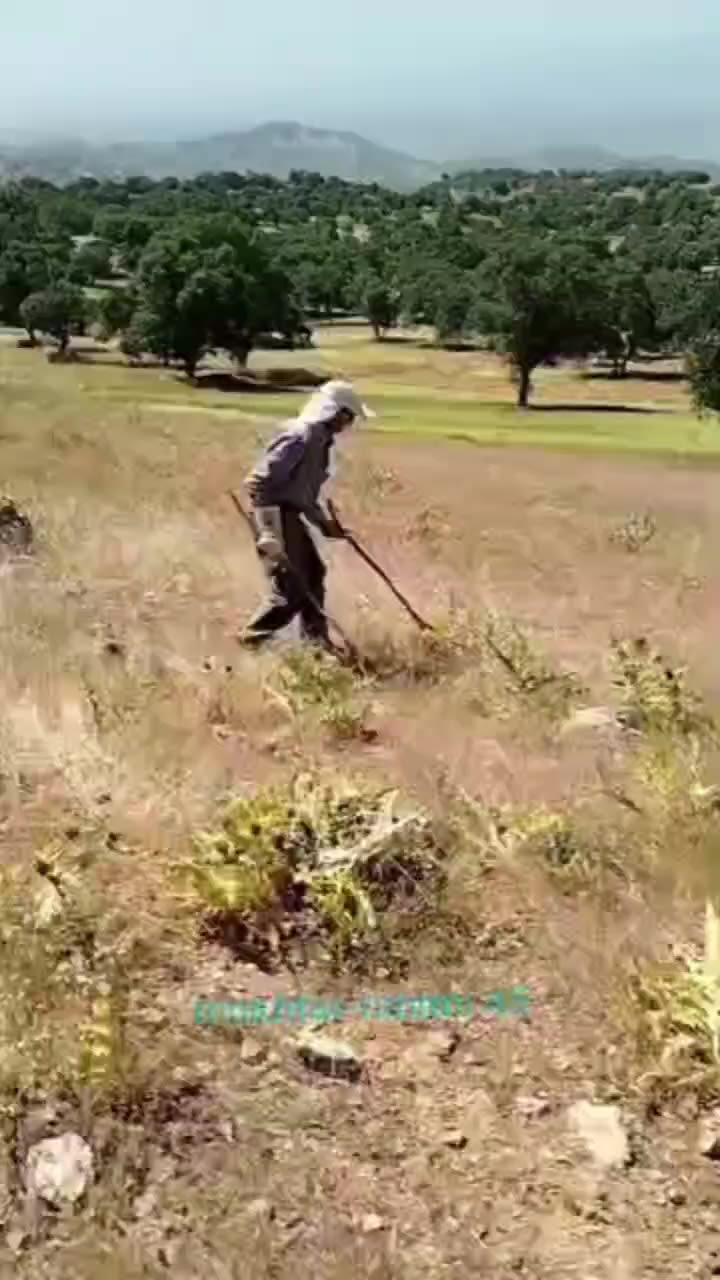
Collecting kangar.
Collecting kangar.
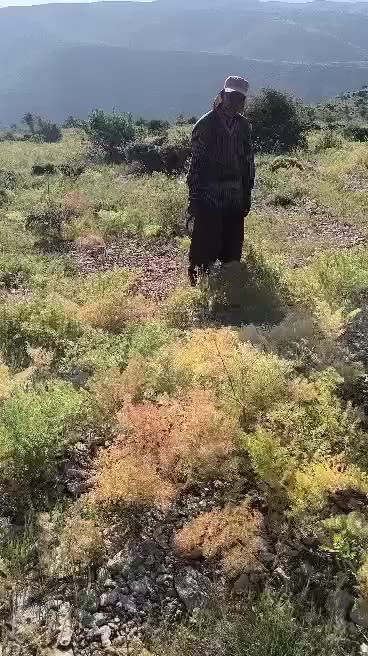
Collecting jashir.
Collecting jashir.
Carpet-Making
"Spinning would often happen in the afternoon after the women had finished their other tasks. They might do this alone or join other women for a chat in a sunny spot."
Production of traditional nomadic bags stopped after the settlement in villages, but two main kinds of carpet-making continued.
Smaller carpets for daily use called gabbeh were made from undyed wool, often with a higher pile and simpler design. More elaborate carpets called ghali were made of dyed wool and had more complex designs.
The making process has many stages and communities developed special tools and techniques to carry out this work, with specific tasks built into the day's work and social activities.
The images and videos that follow capture the process, from washing and shearing sheep and goats, through separating the fibres, spinning, plying and dyeing, to weaving a carpet.
These processes from the 1970s still continue in parts of Iran today.
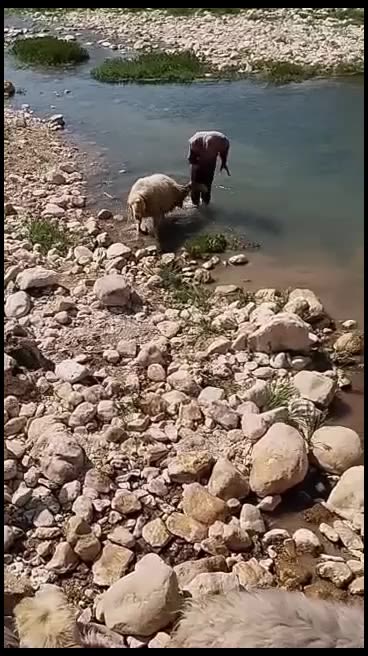
The day before shearing, sheep are washed one at a time in a pool of water to get rid of mud, fleas, and ticks.
Water is carefully rubbed into their fleece, and they are tipped over to ensure the whole animal gets washed.
The video below, captured by Morteza and Laleh Razmjooei, shows this process as it is carried out today.
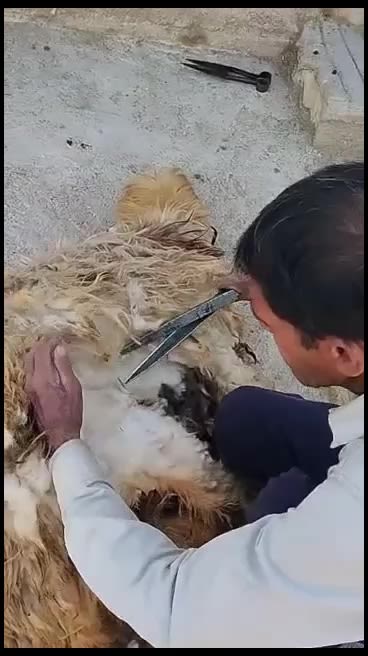
To shear the sheep the animal is laid on its side with its legs carefully tied together to stop it moving as the shears are sharp.
The shears, called chehreh, are two knives, either separate or joined at the handle in the form of a spring.
These techniques have been passed down by families and remain the same today.
Rough wool from the sheep's legs and underbelly is mixed with goat's hair and is hit with a flexible stick from the berchu tree to separate the fibres. The fibres are then fluffed up by hand, in a heap. These fibres will be used for the warp of carpets and for making shalleh, torbeh and tavar.
The fibres of good wool are separated by hand and twisted into a braid and then a hank that fits under the woman's arm. This is spun to make the warp threads and the pile of a carpet.
Spinning would often happen in the afternoon after the women had finished their other tasks.
They might do this alone or join other women for a chat in a sunny spot to smoke a water pipe.
To prepare the warp for a carpet, two balls of spun yarn are re-spun together to make it two-ply. Further steps are taken to make the yarn tight, strong and ready to be used.
This is precise, skilled and time-consuming work.
In a process called sir ba, the two-ply yarn is strung out from a doorway to a tripod at the end of the yard, and twisted again using whorl spindles.
The yarn is then soaked in water for a couple of days and stretched to make it completely tight in a process called dik outha.
“In the 1970s, most wool was taken to Shiraz for dyeing, though some still remembered how women used to do it from home using large cooking pots.
The colours used for dyes came from plants and minerals found locally, or crystals bought in Shiraz.
Natural wool was used for white, brown and black. One red came from pomegranate skin and another from dyer's madder called ronas.
The green hulls of walnut produce a brown dye, green came from a plant called khushk, mustard from turmeric and dark blue from indigo crystals. Two substances calledasheghar and zaj were used as mordants to fix the colours.
These present day images show wool being prepared for dyeing.
These present day images show wool being prepared for dyeing.
Carpets were woven on a flat loom in the courtyard of a carpet weaver’s house. The process is equal parts engineering and art.
Four stout oak posts were solidly driven into the ground and metal clamps attached these posts to two large beams (bon-e zom and sar-e zom) that held the carpet warp in tension.
Press the button below to find out more about how carpet looms were made and used.
In setting up the loom great care is required to get the correct tension on the two levers that raise and lower the alternate warp threads.
If it rained, the tripods and the tension stretchers on the upright posts were quickly disassembled so the partially finished carpet could be rolled up and stored under shelter.
It only took a morning to reassemble the loom once the weather cleared.
To keep the weavers company and share news, other women would gather round the loom in the afternoon, whilst looking after their small children or doing a portable task like spinning.
Each knot was made by hand and when a whole row of knots was complete, they bashed it with a heavy metal comb called a karkit to make the weave dense. Then they pulled the pile upright with their fingers and trimmed it level with a knife or scissors.
Karkit کرکیت
Karkit کرکیت
It took about 25 days for 2 or 3 women, sitting side by side, to weave a carpet – if they didn’t have to take it up for rain.
Here the woman is tying the warp to make the fringe - the final touches to a completed carpet.
Families would pay one of the village’s good weavers 200-250 toman (then £20-25) for their work and provide a rice and chicken dinner to celebrate its completion.
When the work was finished, the carpets were held up to reveal the glory of the colours and the patterns.
Designs, Meanings & Use
"The carpets produced were not just practical items. Each one had specific details to appreciate."
The carpet-makers did not work from a written pattern. When they saw a carpet from elsewhere with a new design they liked, they copied it as they wove.
Fashions changed over time. In the 1960s, carpets with an orange background were popular, but in the 1970s maroon was more common. Many of the design features had specific names and weavers would talk to each other about which ones to use and in which colours.
The images below highlight the range of carpets produced for different uses and some of the key details in their design.
Carpets were sized so the length would fit the width of a house, which in turn was determined by the length of oak or poplar trunks used for rafters.
When there were guests, two or three carpets would be laid out side by side to cover the floor of a house. They might also be laid under a mattress for extra warmth when sleeping.
Only rarely would they be used outside on the dusty ground, if there was an important guest who wanted to enjoy a sunny afternoon.
Carpets had two main designs. One with three diamonds as the central feature, called shah samavari and the other with a chamfered rectangle in the centre called a howz.
This carpet has a howz containing a stylised tree of life and four blue corners, called lackak, containing symbols for a person. It was woven by Mrs Manovar Razmjooei to celebrate the birth of her first son.
The name Sohrab and the date 1329 (1950-1951) are woven either side of the tree.
Gabbeh, the thicker rugs made of undyed wool for everyday use often had the shah samavari design, meaning the three triangles (shah) are assembled on top of each other like the elements of a samovar.
"I used this gabbeh under a mattress to sleep on a rooftop in the summer."
Tap the images below to find out more about the designs of different carpets.
Every house had vibrant carpets with variations on these designs. This carpet was made in 1966. The three squared shah ghacheh resemble the belaying cleats used to tighten a load on a donkey. These shah are much more difficult to weave than the usual diamonds. Each contains a diamond full of small flowers and there are numerous stylised flowers in the background.
Every house had vibrant carpets with variations on these designs. This carpet was made in 1966. The three squared shah ghacheh resemble the belaying cleats used to tighten a load on a donkey. These shah are much more difficult to weave than the usual diamonds. Each contains a diamond full of small flowers and there are numerous stylised flowers in the background.
This carpet has a howz with a tree of life, and also unusual motifs resembling calligraphy.
This carpet has a howz with a tree of life, and also unusual motifs resembling calligraphy.
The central feature of this howz is a toranj (ترنج), variously thought to represent half a fruit or a turtle.
The central feature of this howz is a toranj (ترنج), variously thought to represent half a fruit or a turtle.
This carpet has a tree of life with four strange motifs like upside down buildings halfway up. There are four toranj in the corners.
This carpet has a tree of life with four strange motifs like upside down buildings halfway up. There are four toranj in the corners.
"I asked about the strange figures in this carpet, either side of the right-hand diamond. It was very rare to depict humans in Islamic art and they looked a bit human, but had very big heads. 'Oh', the woman replied, 'I was weaving this when men with big helmets landed on the moon! ’So I knew this carpet was made in 1969."
"I asked about the strange figures in this carpet, either side of the right-hand diamond. It was very rare to depict humans in Islamic art and they looked a bit human, but had very big heads. 'Oh', the woman replied, 'I was weaving this when men with big helmets landed on the moon! ’So I knew this carpet was made in 1969."
Carpets were sized so the length would fit the width of a house, which in turn was determined by the length of oak or poplar trunks used for rafters.
When there were guests, two or three carpets would be laid out side by side to cover the floor of a house. They might also be laid under a mattress for extra warmth when sleeping.
Only rarely would they be used outside on the dusty ground, if there was an important guest who wanted to enjoy a sunny afternoon.
Carpets had two main designs. One with three diamonds as the central feature, called shah samavari and the other with a chamfered rectangle in the centre called a howz.
This carpet has a howz containing a stylised tree of life and four blue corners, called lackak, containing symbols for a person. It was woven by Mrs Manovar Razmjooei to celebrate the birth of her first son.
The name Sohrab and the date 1329 (1950-1951) are woven either side of the tree.
Gabbeh, the thicker rugs made of undyed wool for everyday use often had the shah samavari design, meaning the three triangles (shah) are assembled on top of each other like the elements of a samovar.
Every house had vibrant carpets with variations on these designs. This carpet was made in 1966. The three squared shah ghacheh resemble the belaying cleats used to tighten a load on a donkey.
These shah are much more difficult to weave than the usual diamonds. Each contains a diamond full of small flowers and there are numerous stylised flowers in the background.
This carpet has a howz with a tree of life, and also unusual motifs resembling calligraphy.
The central feature of this howz is a toranj, variously thought to represent half a fruit or a turtle.
This carpet has a tree of life with four strange motifs like upside down buildings halfway up.
There are four toranj in the corners.
"I asked about the strange figures in this carpet, either side of the right-hand diamond.
It was very rare to depict humans in Islamic art and they looked a bit human, but had very big heads.
'Oh', the woman replied, 'I was weaving this when men with big helmets landed on the moon! ’
So I knew this carpet was made in 1969."
"During my fieldwork I made notes on the different colours and designs used in carpets and got to know different weavers by name."
This carpet, or ghali, was woven by Mrs Belgheiss Razmjooei. It was collected in 1992.
This carpet uses the shah samavari design, with little arms or baghalak stretching out from the diamond’s sides.
Each aspect of the design has a name, as seen in the features highlighted below.
In the background is a scattering of different stylized flowers called bouteh-ye gol.
Sometimes there would also be stylised goats, camels or birds.
This diagonal wide zigzag is called yalmah.
It is decorated with little flowers on stalks called pertaki.
Inside each diamond is a smaller diamond with a geometric figure. This depicts shepherds’ crooks, called kilak yalmah, around the edge, with a field of flowers in the centre.
This section shows various stylised flowers called called gol-e pialehii.
The light coloured symbol like an inverted 'V' is upside down and is a stylised goat’s head and horns.
Symbols like this are called kerenjal, meaning moving in all directions.
This border pattern is also called kerenjal.
Postscript
"During the Islamic Revolution in 1979, conflicts meant many people left the villages and moved to Shiraz. Their village carpets did not fit the larger, square rooms of town houses, so they replaced them with either machine-made carpets or hand-made carpets from other towns."
Town house with large hand-woven carpets, poshti carpet-cushions and traditional balesht home-made and embroidered bolster cushions.
Town house with large hand-woven carpets, poshti carpet-cushions and traditional balesht home-made and embroidered bolster cushions.
"When I returned to the area in 1995, a company had set up a factory near the winter quarters village to make gabbeh for export to western furniture chain stores. The quality of materials, designs and craftsmanship had declined from village standards. The wages were low in comparison to the prices these carpets fetched in European markets.
Now there are no longer any women weaving traditional carpets in the villages where I did fieldwork.
I hope this exhibition can help to preserve the memory of these people and their practices."
Acknowledgements
Professor Susan Wright would like to thank the people of Doshman Ziari who patiently and generously shared their knowledge.
Special thanks go to Mr Siamarz Razmjooei and Mrs Farkhnaz Razmjooei who participated in annotating all of my 1970s photographs, they also arranged for the more recent photographs and videos and helped edit this online exhibition.
They designed the model loom and gathered experienced weavers, Mrs Golandam Razmjooei and Mrs Homayun Razmjooei, to demonstrate and record all the stages of setting it up. They also arranged for Mr Morteza Razmjooei and Mrs Laleh Razmjooei to make the videos of washing and shearing sheep and harvesting jashir. Thousand thanks!
I would also like to thank Mr Mokhtar Rahimi from Serenjelak village, Doshman Ziari, for kindly giving permission to use his video of Mr Mozafar Rahimi harvesting kangar. It is overlain with my recording of singing by the late Mr Panji (Panj Ali) Razmjooei.
I am extremely grateful to master’s student Abbie Kozlowska and to David Wright of the Durham University Museums, Galleries & Exhibitions Team for their design ideas and unwavering support in developing this online exhibition.
Additional thanks to Dr Dalir Barkhoda for help in preparing the photographs, and to master's student Alexander Valbjørn Nielsen who helped with the editing.
I also thank the British Institute for Persian Studies for the grant ‘Kinship, Carpets and Politics: Transformations in Doshman Ziari, Mamasani in relation to the Shah’s Modernising State’.
We'd love to know what you thought about the exhibition. Follow the link below for a short feedback form.
About the Author
The original research that underpins this exhibition was conducted as part of Susan Wright’s PhD in social anthropology at Oxford University. She was only able to return to Iran for short visits (In 1992, 1995 and 1996) and went on to study how people engaged with major political transformations in other contexts, notably neoliberal forms of governance in the UK in 1980s and 1990s, and university reforms in Europe since 2000.
At the time of making this online exhibition in 2026, she is Professor of Educational Anthropology at Aarhus University, Denmark and is grateful to a Leverhulme Visiting Professorship in Anthropology at Durham University for the opportunity to return to her Iranian research and work on developing ideas about ‘participatory governance’ across all her research fields.
Copyright
The contents of this exhibition are under copyright and images are not to be reproduced without permission. Images and videos copyright of Professor Susan Wright. Exhibition design copyright of Durham University.
 Built with Shorthand